In the world of lighting technology, understanding LED types is crucial. Many people ask, "What is the difference between COB and SMD LEDs?" These two types are popular, but they serve different purposes. COB (Chip on Board) and SMD (Surface Mount Device) LEDs each have unique attributes affecting brightness, efficiency, and thermal management.
COB LEDs comprise multiple small chips bonded directly to a substrate. This design allows for better light distribution and higher brightness. On the other hand, SMD LEDs are compact and widely used for their versatility. They are easier to install and are often more cost-effective. However, SMD LEDs may not perform as well in certain applications.
Several factors come into play when comparing these technologies. So, knowing which LED type suits your needs is essential. It's not just about choosing the cheaper option; understanding how each one works will lead to better decisions. Exploring these differences opens up more possibilities for effective lighting solutions.
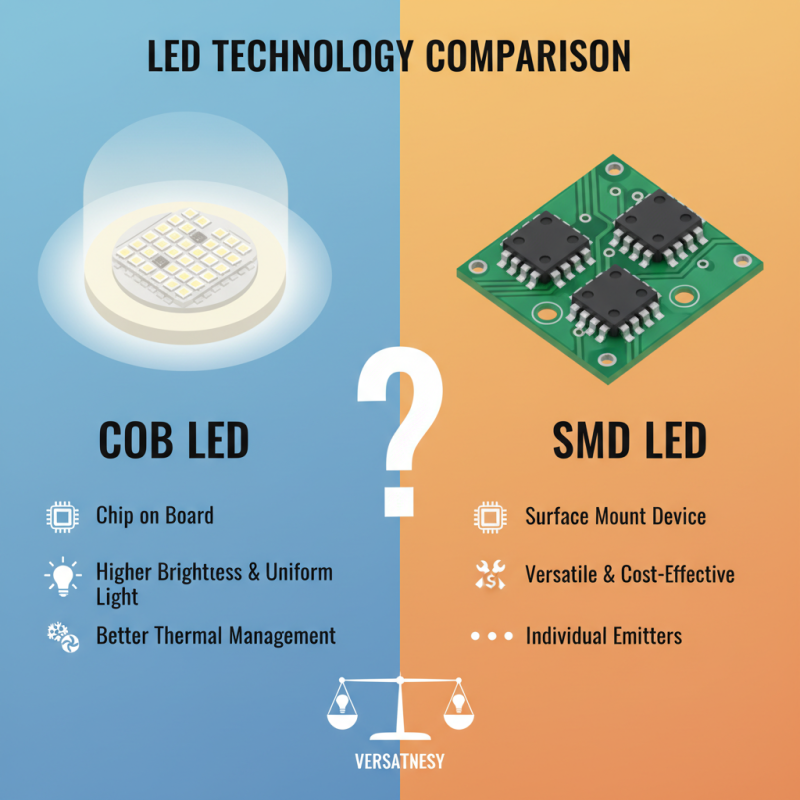
Advantages of COB LEDs Over SMD LEDs
COB LEDs, or Chip on Board LEDs, offer several advantages over traditional SMD, or Surface Mounted Device, LEDs. One major benefit is their efficiency in thermal management. COBs can dissipate heat more effectively, enhancing the lifespan of the light source. This aspect makes them suitable for high-output applications where maintaining temperature is crucial.
Another advantage is the improved color consistency. COB LEDs emit light with a unified color spectrum, reducing the variations seen in SMD LEDs. This feature is essential for architectural and retail lighting, where color accuracy plays a significant role. When lighting is uniform, it enhances the overall aesthetics.
Tip: Consider your lighting needs carefully. If you require bright, consistent output, COB may be your go-to choice.
While COB LEDs are cost-effective in the long run, they may have higher initial costs compared to SMDs. It's important to weigh the upfront investment against operational savings. In environments with fluctuating power sources, the stability of COB lighting often proves to be a strong point.
Tip: Assess the total cost of ownership when selecting LED types. Short-term expenses can obscure potential savings over time.
Heat Dissipation: COB vs SMD Technology
Heat dissipation is a critical factor in LED technology.
COB (Chip on Board) and
SMD (Surface Mount Device) LEDs differ significantly in this aspect.
COB LEDs integrate multiple small chips onto a single board.
This design increases light output and enhances thermal management.
The compact arrangement allows for better heat conduction, minimizing hotspots and leading to a uniform temperature distribution.
In contrast, SMD LEDs consist of individual chips mounted on a circuit board.
While this design can fit varied applications, it often results in less efficient heat dissipation.
Heat can accumulate around individual components, leading to potential overheating.
Over time, this can affect both performance and lifespan.
Although both types have their strengths, COB technology generally excels at managing heat.
However, it's essential to acknowledge potential drawbacks. COB LEDs can be harder to replace when they fail.
SMD LEDs offer flexible arrangements that might be more user-friendly.
Furthermore, the specific application should dictate the choice.
Assessing heat management needs is essential for optimal performance and longevity.
Brightness and Light Output Comparisons
When comparing COB and SMD LEDs, brightness and light output are critical factors to consider. COB, or Chip-on-Board, LEDs provide a higher lumen output per watt. They are designed to emit light from a larger surface area. This creates a more uniform light distribution. Users often report a pleasant lighting experience with COB LEDs in various applications.
On the other hand, SMD, or Surface-Mounted Device, LEDs offer versatility. They can be configured in different sizes and shapes. This flexibility allows for creative lighting designs. However, SMD LEDs may exhibit a slightly lower brightness compared to COB. Some users notice hot spots or uneven lighting when SMD LEDs are used extensively.
In terms of light intensity, COB excels in tasks requiring focused lighting. It performs well in spaces needing significant brightness, like workshops. In contrast, SMD is ideal for decorative lighting where diffusion is more important. Both options have their strengths and weaknesses. The choice depends on the specific lighting needs of the space. This decision-making process can benefit from reflection on the intended use.
Brightness and Light Output Comparisons between COB and SMD LEDs
Size and Design Flexibility in COB and SMD LEDs
When comparing COB (Chip-on-Board) and SMD (Surface-Mount Device) LEDs, size and design flexibility are critical factors.
COB LEDs integrate multiple chips into a single module. This compact design allows for higher lumen output in a smaller footprint. According to a report by McKinsey, using COB technology can improve light efficiency by up to 30%. Designers appreciate this technology, as it enables more streamlined applications in limited spaces.
In contrast, SMD LEDs offer versatility in shape and size. They can be effortlessly integrated into various devices, such as automotive lights or home fixtures. The modular nature of SMD technologies supports a wide array of designs. This adaptability can lead to better thermal management and enhanced light quality, making it a preferred choice for many applications.
However, their spread-out configuration may result in reduced overall brightness compared to COB.
Both technologies feature unique challenges. While COB allows for compact lighting solutions, their heat dissipation can be a concern in high-output applications. On the other hand, SMD LEDs require precise alignment during installation to ensure optimal performance. Evaluating these nuances helps manufacturers choose the best solution for their specific needs, while balancing efficiency against design flexibility.
Cost and Efficiency: COB LEDs Compared to SMD LEDs
When comparing COB (Chip on Board) LEDs to SMD (Surface-Mounted Device) LEDs, cost and efficiency take center stage. COB LEDs generally have a higher initial cost. However, their long-term efficiency can compensate for that. These LEDs have a higher light output per watt, making them ideal in applications where efficiency is crucial. The compact nature of COB technology allows more light to be produced from a smaller area, enhancing their performance in space-limited designs.
On the other hand, SMD LEDs are more affordable and widely used in consumer products. Their lower cost makes them attractive for large-scale applications. However, they often require more space due to their larger heat sink needs. This can lead to more complex designs. While SMD LEDs might be cheaper upfront, they might not offer the same energy savings as COB alternatives over time.
The trade-offs between these two technologies can spark considerable discussion. Users must weigh the initial cost against potential energy savings and output efficiency. In some cases, the choice might depend solely on the specific application requirements rather than pure cost. Understanding these nuances is key for informed decisions in lighting design.
10 Best Differences Between COB and SMD LEDs
| Feature |
COB LEDs |
SMD LEDs |
| Light Output |
High lumen output |
Moderate lumen output |
| Size |
Larger size |
Compact size |
| Heat Management |
Better heat management |
Less efficient heat dissipation |
| Color Quality |
Superior color rendering |
Good color rendering |
| Efficiency |
Higher efficiency |
Moderate efficiency |
| Application |
Ideal for large fixtures |
Preferred for small devices |
| Cost |
Generally higher |
Usually lower |
| Lifespan |
Longer lifespan |
Shorter lifespan |
| Light Distribution |
Uniform light distribution |
Directional light distribution |
| Weight |
Heavier |
Lighter |
FAQS
: COB LEDs can manage heat more effectively, enhancing their lifespan.
COB LEDs emit light with a unified color spectrum, reducing variations seen in SMD LEDs.
Yes, they can be cost-effective long-term due to operational savings.
COB LEDs typically provide higher lumen output and uniform light distribution than SMD LEDs.
Spaces requiring significant brightness, like workshops, benefit from COB's focused lighting.
SMD LEDs can be configured in various shapes and sizes, allowing for creative designs.
Heat dissipation can become a concern when using COB in high-output settings.
SMD LEDs can provide better design versatility and suitable solutions for decorative lighting.
Yes, SMD LEDs may show hot spots or uneven lighting if not properly utilized.
Reflect on specific lighting needs and the intended use to make an informed decision.
Conclusion
When exploring the question, "What is the difference between COB and SMD LEDs?", it is essential to consider several key aspects. COB (Chip-on-Board) LEDs generally offer significant advantages over SMD (Surface-Mounted Device) LEDs. They provide enhanced heat dissipation due to their integrated design, which allows for better thermal management. In terms of brightness and light output, COB LEDs typically produce higher lumen levels compared to their SMD counterparts, making them suitable for applications requiring intense illumination.
Moreover, the size and design flexibility of COB and SMD LEDs play a crucial role in their usage. COB LEDs enjoy a compact design, allowing for innovative fixture designs, while SMD LEDs can be more versatile in varied applications. Lastly, cost and efficiency considerations reveal that while COB LEDs may have a higher upfront cost, they often lead to lower energy consumption and longer lifespans, making them more economical in the long run. This comprehensive comparison highlights the distinct characteristics that differentiate COB and SMD LED technologies.
 Ledic Lighting
