What Is the Best IP Rating for Outdoor Soffit Lighting? The answer depends on exposure, drainage, maintenance, and installation quality. A covered porch may face occasional splashes. An exposed eave may receive wind-driven rain, dust, and spray from garden equipment. The fixture’s label cannot tell the whole story.
IEC 60529 defines IP protection levels through testing. IP44 resists solid objects above 1 millimeter and water splashes. IP65 adds dust-tight construction and protection against water jets. IP66 offers stronger water-jet resistance. IP67 includes temporary immersion, but it does not automatically replace every higher rating. The National Electrical Manufacturers Association also warns that enclosure ratings require correct installation and environmental matching. These standards provide a useful technical baseline, not a guarantee of long-term performance.
James Benya, a recognized lighting designer and author, has said, “Outdoor lighting should respond to the environment, not merely illuminate it.” That principle matters beneath a soffit. For most sheltered outdoor soffits, IP44 or IP54 may be sufficient. For exposed coastal homes, open porches, or areas washed by heavy rain, IP65 is often the safer practical choice. IP66 may be justified where powerful spray is possible. IP67 can be excessive beneath a normal roofline, unless flooding or temporary submersion is realistic. Still, this guidance is not perfect. A poorly sealed cable entry can defeat an excellent rating. Check the gasket, junction box, mounting angle, and drainage path. The smallest detail may decide whether the light survives its first harsh winter.
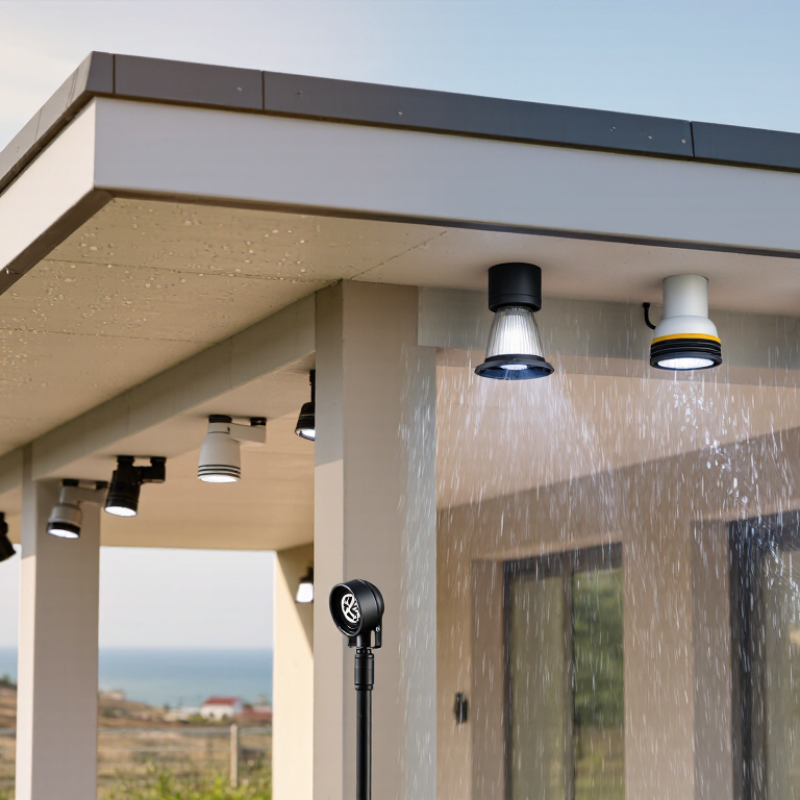
For outdoor soffit lighting, an IP code is more than a marketing label. Defined by IEC 60529, it describes how an enclosure resists solids and water. The first digit measures protection against dust and contact. A 6 means dust-tight, tested under controlled conditions. A 5 means limited dust ingress, while lower ratings offer less protection. These numbers do not measure brightness, corrosion resistance, or electrical efficiency. That distinction is easy to miss.
The second digit concerns water entry. IPX4 withstands splashing from any direction. IPX5 tests resistance to water jets. IPX6 uses more powerful jets, and IPX7 evaluates temporary immersion. IPX8 covers continuous immersion under conditions specified by the manufacturer. An IP65 fitting is dust-tight and jet-resistant, but it is not automatically rated for immersion. The test methods are specific; garden hoses and storms are not identical laboratory conditions.
Under a soffit, IP65 or IP66 is often a practical starting point, especially near wind-driven rain. Use IP67 only when temporary pooling or flooding is credible and the product permits that use. Installation still matters. Cable entries, cutouts, seals, and mounting angles can weaken the intended protection. I have seen a well-rated fitting fail after an unsealed connector collected water. Check the complete assembly, not only the lamp housing. Ratings can be misunderstood. Review the stated test conditions, drainage path, and maintenance access before choosing.
Under IEC 60529, the first digit indicates protection against solid particles and dust, while the second digit indicates protection against water entry. IP65 is a practical minimum for exposed outdoor soffit lighting because it is dust-tight and protected against water jets. IP66 provides stronger water-jet protection. IP67 and IP68 address temporary or continuous immersion, but they do not automatically include protection against powerful water jets unless the product is separately marked, such as IP66/IP67.
Outdoor soffit lighting needs more than a high-looking number. In field checks, I focus on the second IP digit because rain, spray, and trapped moisture create different risks. IP65 means dust-tight protection against water jets from any direction. It suits many covered soffits exposed to wind-driven rain. That is not immersion protection.
IP66 uses a stronger water-jet test, making it more suitable for exposed eaves, storm-driven rain, and occasional cleaning spray. IP67 uses a different test entirely: temporary immersion in up to one metre of water for 30 minutes. It does not automatically prove protection against powerful jets. This distinction matters. A fitting marked only IP67 may still need separate jet protection.
I once treated IP67 as automatically better for every outdoor installation. That assumption was incomplete. For a soffit facing heavy rain, IP66 may address the real hazard more directly. Where flooding or standing water is possible, IP67 adds valuable immersion resistance. If both conditions exist, look for dual-rated protection, such as IP66 and IP67, rather than guessing from one number. Check the cable glands, connectors, and mounting angle too. A sealed housing can still fail through a poorly tightened entry point. Leave drainage paths clear, and inspect seals after installation. Small gaps matter.
The best IP rating for outdoor soffit lighting depends on real exposure, not appearance. A deep soffit may block direct rain, yet wind-driven water can reach the fixture from several angles. Coastal homes also face salt-laden moisture and fine dust. Examine nearby gutters, roof edges, trees, and open walls before choosing a rating.
For covered soffits, IP65 is often a practical starting point because it resists dust and water jets. Areas exposed to heavy storms may justify IP66, which offers stronger protection against powerful water jets. IP67 can help where temporary water immersion is possible, although it does not automatically solve every outdoor risk. The rating should match the installation, not simply look impressive on a specification sheet.
Condensation deserves equal attention. Warm indoor air can meet a cold fixture housing and create moisture inside, especially during seasonal temperature changes. Sealed fittings reduce water entry, but poor cable glands or damaged seals can still cause failure. I once assumed a sheltered overhang eliminated most risk; inspection proved otherwise after wind pushed rain behind the fascia. Check drainage, mounting angles, joints, and cable entries carefully. Follow the applicable IP testing standard, such as IEC 60529, and use qualified electrical guidance for local conditions. Even the correct rating cannot compensate for careless installation.
For outdoor soffit lighting, the right IP rating depends on how much weather reaches the fixture. IP65 is usually suitable beneath sheltered eaves, where the roof blocks direct rain but wind can still carry moisture sideways. Under IEC 60529, the first “6” means complete dust protection. The second “5” means resistance to water jets from any direction.
IP67 is the safer choice for fully exposed installations. Its testing allows temporary immersion in water up to one metre for 30 minutes. That sounds stronger, and often is. However, IP67 alone does not automatically guarantee protection against powerful water jets. IEC 60529 treats jet resistance and immersion as different tests. An exposed fitting may need an IP66/IP67 rating when storms, washing, or roof runoff are realistic concerns.
Details matter more than the label.
During site checks, I look for pooling water, open cable entries, and soffit cavities that trap condensation. A high rating cannot rescue poor installation. Cable glands must match the enclosure, and connectors should face downward where practical. The U.S. National Electrical Manufacturers Association also separates enclosure performance by environmental exposure, reinforcing the need to assess the installation site rather than choose by rating alone. IP65 fits many protected eaves. IP67 fits locations where water can reach the fixture directly. Still, drainage and sealing deserve equal attention. That is where many otherwise careful installations fall short.
| Installation Condition | Recommended IP Rating | Protection Against Solids | Protection Against Water | Typical Outdoor Suitability | Key Installation Considerations |
|---|---|---|---|---|---|
| Covered soffit with a deep, sheltered eave | IP65 | Dust-tight; no ingress of dust under the applicable test conditions. | Protected against water jets from any direction. | Generally suitable | Keep the fitting away from direct splash zones, make sure cable entries face downward where possible, and use correctly sealed junction boxes and connectors. |
| Soffit exposed to wind-driven rain | IP65 minimum | Dust-tight. | Resistant to water jets, but not specifically rated for temporary immersion. | Suitable when installed correctly | Assess the building location, prevailing weather, drainage, and the likelihood of water collecting around the fitting or its cable entry. |
| Fully exposed underside with heavy rain or frequent splashback | IP67 | Dust-tight. | Protected against temporary immersion in water up to 1 metre for up to 30 minutes under the applicable test conditions. | Preferred for higher exposure | Use sealed fittings and glands, maintain the manufacturer’s mounting orientation, and prevent water from pooling around the product. |
| Location that may experience both water jets and temporary immersion | IP65/IP67 | Dust-tight. | Provides both water-jet protection and temporary-immersion protection when both ratings are explicitly stated. | Best where exposure is unpredictable | Do not assume that IP67 alone includes IP65 water-jet protection. Check that the complete product rating includes both tests. |
| Area subject to permanent or prolonged submersion | Not covered by IP65 or IP67 alone | Dust protection depends on the stated rating. | IP67 covers temporary immersion only; it does not establish suitability for continuous immersion. | Not suitable without a specific rating | Select equipment specifically rated for the intended depth and duration of immersion, and follow local electrical installation requirements. |
| Coastal or high-salt outdoor environment | IP65 or IP67, plus suitable corrosion resistance | Dust-tight when the selected rating begins with “6”. | Water protection depends on the second digit; IP rating does not measure salt corrosion resistance. | Use with additional material protection | Look for corrosion-resistant housing and fasteners, inspect regularly, and use installation materials appropriate for marine or coastal conditions. |
| General selection rule for outdoor soffit lighting | IP65 for sheltered eaves; IP67 for fully exposed areas | Both ratings provide the highest dust-protection level represented by the first digit. | IP65 is tested for water jets; IP67 is tested for temporary immersion. | Match the rating to actual exposure | The IP rating applies to the tested enclosure. The finished installation also depends on sealed cable entries, connectors, junction boxes, mounting orientation, and correct maintenance. |
Outdoor soffit lighting needs more than a high IP number. Verify the complete installation against UL 2108, the National Electrical Code, and the manufacturer’s technical data. UL 2108 addresses low-voltage lighting systems, including installation safety and system components. It does not replace location-specific code requirements. Under NFPA 70, 2023 NEC, Section 410.10(D), luminaires in damp or wet locations must be identified for that environment. A covered soffit may still receive wind-driven rain.
IP65 usually protects against dust and water jets.
IP67 adds temporary immersion protection.
That extra rating is useful near exposed roof edges, but it cannot correct poor wiring or an unsuitable power supply. IEC 60529 defines these IP tests, not the entire installation. Check operating temperature, cable entry seals, drainage, and approved mounting surfaces. Manufacturer data should state the permitted location clearly. Vague wording is a warning sign.
Tips: Photograph the soffit, junction box, and labels before installation. Confirm the listing matches the assembled system, not only the lamp. Check NEC requirements with a qualified electrician. Leave a small drainage path where the housing design allows it. I have seen “weatherproof” products fail because connectors remained exposed. That detail is easy to miss. Also, IP testing uses controlled conditions, while real soffits face dust, insects, condensation, and seasonal movement. Recheck the specification before cutting the first hole.
An IP code measures protection against solid particles and water entry. It does not measure brightness, corrosion resistance, or electrical efficiency. That distinction matters.
The first digit describes protection from dust and accidental contact. A rating of 6 means the enclosure is dust-tight under controlled testing. A rating of 5 allows limited dust entry.
IPX4 resists splashing from different directions. IPX5 resists water jets, while IPX6 handles stronger jets. IPX7 covers temporary immersion. IPX8 covers continuous immersion under specified conditions.
IP65 is often a practical starting point for covered soffits. It is dust-tight and resists water jets. However, it is not automatically suitable for immersion. Do not rely on the number alone.
IP66 may suit soffits exposed to heavy, wind-driven rain. IP67 can help where temporary pooling or flooding is possible. Use it only when the product permits that installation. Higher is not always better.
Not completely. Wind can push rain behind fascia boards and toward the fitting. Nearby gutters, roof edges, trees, and open walls also affect exposure. Shelter can reduce risk, but it does not remove it.
Unsealed cable entries, damaged gaskets, exposed connectors, and poor cutouts can admit water. Mounting angles may also trap moisture inside the housing. Check the complete assembly, not just the lamp enclosure. A small connector can become a collection point.
Warm indoor air can meet a cold fixture and create internal moisture. Seasonal temperature changes may increase this risk. Sealed fittings help, but they cannot fix poor drainage or damaged seals. I once underestimated this risk. Inspection changed my view.
Review the IEC 60529 test conditions and the complete technical data. Confirm the permitted location, operating temperature, cable seals, and mounting surface. Check local electrical requirements with a qualified electrician. Photograph the soffit, junction box, and labels first. Small details matter.
What is the best IP rating for outdoor soffit lighting? The answer depends on how exposed the fixture will be. Under IEC 60529, the first IP digit measures protection against dust, while the second indicates resistance to water entry. IP65 protects against dust and water jets, IP66 adds stronger protection against powerful water jets, and IP67 allows temporary immersion. These ratings help homeowners and installers evaluate performance in realistic outdoor conditions.
For soffits beneath sheltered eaves, IP65 is often suitable when the fixture is protected from direct rainfall and severe wind-driven water. Fully exposed installations may benefit from IP67, especially where heavy rain, splashback, condensation, or occasional pooling could occur. Before installation, confirm the fixture’s test data and suitability for the location, and review applicable UL 2108 requirements, NEC provisions, wiring methods, and manufacturer instructions. Proper sealing, drainage, and installation are also essential for long-term safety and reliable lighting performance.

Ledic Lighting