Ledic Lighting
The Paradigm Shift in Smart Architectural Lighting Systems
How custom OEM magnetic track lights are disrupting classical retail, hospitality, and residential lighting architectures via modular integration and low-voltage configurations.
Modern commercial and residential architectural designs increasingly demand dynamic lighting environments that can evolve alongside changing spatial layouts. Traditional fixed downlights and rigid track lighting systems are no longer sufficient to meet the requirements of modern spaces. This has catalyzed the rapid adoption of low-voltage magnetic track lighting systems. Operable on Safe Extra Low Voltage (SELV) 48V DC, these systems allow tool-free spatial layout reconfigurations. Lighting designers can easily reposition, add, or swap modules like linear spotlights, accent projectors, and wall-washers to customize the distribution of light.
For global importers, engineering distributors, and architectural lighting brands, finding a highly capable OEM LED magnetic track light factory is crucial for project success. A reliable manufacturing partner must offer not only basic assembly, but also custom profile extrusions, sophisticated optical lenses, high-color-rendering LED packaging (CRI > 90, R9 > 50), and drivers that integrate with intelligent control protocols.
Thermal management at the magnetic connection interface is a primary cause of system failure in cheap magnetic tracks. High-quality 48V systems use red copper busbars (purity > 99.9%) and gold-plated contact pins. This configuration maintains contact resistance under 0.05 ohms, preventing localized thermal spikes and voltage drop over long linear runs.
Yuyao Ledic Lighting Equipment Co., Ltd.
Established in 1996, Yuyao Ledic Lighting Equipment Co., Ltd. is a high-tech manufacturer specializing in the research, development, and production of energy-efficient LED lighting systems. Located in Yuyao City, Zhejiang Province, China, our facilities span over 20,000 square meters of advanced manufacturing space.
With over two decades of engineering expertise, we have established ourselves as a trusted global manufacturer. We specialize in both standard and tailored lighting solutions, offering robust OEM and ODM services to clients in Europe, the Middle East, South Asia, and South America.
Tailored OEM/ODM Manufacturing Capabilities
Delivering engineering excellence through vertical integration, from raw aluminum extrusion to final photometric testing.
Custom Extrusion and Finishing
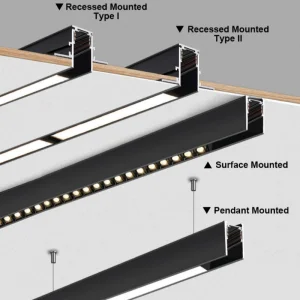
We offer high-tensile 6063-T5 aluminum extrusions with wall thicknesses up to 2.0mm. Available profiles include recessed, surface-mounted, trimless, and suspended designs. Finishes include custom RAL powder coatings, sandblasted anodizing, and electrophoretic options.
Intelligent Driver Integration
Our systems are compatible with industry-leading drivers, including Lifud, Tridonic, and Mean Well. They support Casambi, DALI-2, 0-10V, and Zigbee protocols, delivering smooth dimming down to 0.1% without camera flicker.
Advanced Optical Customization
We offer precise beam distributions, including narrow spot (15°), medium flood (24°), wide flood (36°/50°), and oval wall wash. Lens options include anti-glare micro-prismatic diffusers that keep UGR below 13 for improved visual comfort.
Technical Specifications Matrix for Global OEM Collaborations
To simplify sourcing, our standard and custom magnetic track light assemblies conform to the following architectural metrics:
| Specification Parameter | Standard Offering | Premium OEM Optional Capability |
|---|---|---|
| Operating Input Voltage | 48V DC (Safe Extra-Low Voltage - SELV) | 24V DC / Constant Current configurations |
| LED Light Engine Brand | Bridgelux / Osram SMD & COB series | Cree / Citizen / Luminus high density chips |
| Color Rendering Index (CRI) | Ra ≥ 90, R9 ≥ 50 | Ra ≥ 97, R9 ≥ 90 (Ultra-high fidelity) |
| MacAdam Steps (SDCM) | 3-Step MacAdam Ellipse (≤ 3 SDCM) | 2-Step MacAdam Ellipse for high-end galleries |
| Dimming Range | 10% - 100% (Standard trailing/leading edge) | 0.1% - 100% flicker-free DALI-2 DT8 / Casambi |
| Track Material | Al6063-T5 with Fluorocarbon coating | Architectural Brass / Special Anodized Finishes |
Global Procurement, Sourcing, & Risk Mitigation
Essential factors for procurement directors and importers evaluating suppliers in the East Asian supply chain.
Sourcing commercial-grade LED magnetic track lights involves evaluating more than just the unit price. High-voltage transients, structural integrity, and electronic component quality all impact the total cost of ownership. Sourcing teams should focus on these key factors to minimize project risk:
- Copper Core Cross-Sectional Area: Thin copper rails in the track run can lead to voltage drops. This results in uneven light levels (lumen decay) towards the end of a long track installation. We use at least 2.5 mm² copper profiles to support continuous runs of up to 20 meters without secondary power injection.
- Mechanical Latching Reliability: Magnetic attraction alone may not be sufficient for high-vibration commercial spaces or overhead suspended tracks. High-quality systems should combine neodymium magnets (N35 grade or higher) with mechanical slide-locks or snap-fit clips. This dual-locking mechanism ensures the lighting module remains securely attached to the ceiling track.
- Flicker Index & Driver Harmonics: Drivers must comply with IEEE 1789-2015 flicker standards and maintain a Total Harmonic Distortion (THD) under 15% at full load. This is essential for office, hospitality, and residential environments to prevent eye strain and interference with smart building automation systems.
Rigorous Production Control
At Yuyao Ledic Lighting, our ISO 9001:2015 certified production facility guarantees traceability for all raw materials. Our quality control team manages testing across the production cycle:
- IQC (Incoming Quality Control): We test all LEDs for color consistency and verify the thermal parameters of aluminum substrates and drivers before they reach the assembly floor.
- IPQC (In-Process Quality Control): We run diagnostic checks at every assembly station, including insulation resistance and high-voltage circuit testing.
- OQC (Outgoing Quality Control): Every batch undergoes a 24-hour burn-in cycle and aging test before packaging, ensuring reliable, out-of-the-box performance at the project site.
Architectural Lighting Solutions
Configured layouts designed to meet lighting requirements across commercial office, luxury retail, and high-end residential spaces.
Office & Workspace
The Objective: Reduce glare, improve visual comfort, and maintain uniform light levels across open-plan offices.
Solution: We install recessed, trimless magnetic track layouts fitted with low-glare linear diffusers. These modules deliver high-efficacy, indirect light, keeping unified glare ratings (UGR) below 19 to help reduce eye strain.
High-End Retail
The Objective: Highlight product textures, accurately render colors, and adapt to changing seasonal displays.
Solution: We use adjustable spotlights with ultra-high CRI (CQS ≥ 95) and narrow, directional beam angles. These allow retailers to highlight key merchandise and adjust track modules without tools as store layouts evolve.
Residential & Hospitality
The Objective: Create warm, comfortable environments with flexible, easy-to-control lighting scenes.
Solution: We integrate tunable white track modules (2700K to 6500K) controlled via DALI DT8 or Casambi. This setup allows users to program scenes that mimic natural circadian rhythms, transitioning from energizing daylight to soft, warm evening light.
Localization, Standards, and Global Distribution
Ensuring global compliance, reliable delivery, and support across international markets.
Navigating international regulatory frameworks is essential for global architectural lighting brands. Imported fixtures must comply with local safety and efficiency standards to clear customs and pass electrical inspections. Our products are designed and certified to meet the regulatory requirements of major global markets:
European Union (CE, RoHS, ErP)
Our magnetic track systems are fully CE marked and comply with RoHS environmental regulations. Our drivers meet the latest ErP ecodesign requirements, ensuring high energy efficiency and low standby power consumption.
North America (UL/ETL Standards)
We offer UL and ETL-compliant configurations. Our low-voltage 48V tracks are designed to meet National Electrical Code (NEC) Class 2 limit standards, simplifying installation approvals for commercial spaces.
Middle East & Oceania (SASO, SAA)
We provide SAA-certified tracks and power supplies for Australian and New Zealand projects. We also offer verified CB test reports to help streamline SASO and GCC customs clearance in the Gulf region.
Beyond compliance, we support our clients with a range of technical services. This includes providing detailed IES photometric files for DIALux lighting simulations, helping lighting designers verify lux distributions and glare ratings before placing an order. We also offer project-specific labeling, custom packaging, and flexible shipping options to ensure smooth delivery on-site.
Technology Roadmap & Next-Generation Lighting Developments
A preview of our ongoing R&D projects, focusing on smart wireless controls, improved efficiency, and sustainable materials.
Casambi & Matter Controls
Integrating Matter-over-Thread and Casambi wireless controls directly into 48V magnetic track drivers for smart home systems.
High-Efficiency COB Engines
Developing COB light engines that achieve up to 140 lm/W at Ra ≥ 90, reducing thermal load and overall energy use.
Recyclable Track Profiles
Transitioning to post-consumer recycled aluminum for track profiles and bio-based plastics for lens components.
Narrow-Beam Optical Systems
Designing 5° and 8° micro-optic lenses for high-ceiling retail accentuation and precise wall washing.
Frequently Asked Technical Questions (FAQ)
Detailed answers to common questions about selecting, installing, and configuring low-voltage magnetic track lighting systems.
Q1: What are the main benefits of using a 48V DC magnetic track system over a traditional 220V or 110V AC track system?
A: Safety and flexibility. Operable on Safe Extra Low Voltage (SELV), 48V DC systems carry no risk of electrical shock during installation or adjustment. This allows users to hot-swap, add, or reposition light modules along the track without turning off the power. Additionally, 48V tracks are more compact, permitting slim, minimalist profiles that can be installed flush in drywall.
Q2: How do you address voltage drop along long linear runs of 48V magnetic track?
A: Voltage drop can occur if the copper conductors in the track are too thin, causing lights at the end of the run to dim. To prevent this, we extrude our tracks with thick, high-conductivity red copper busbars (up to 2.5 mm²). For continuous track runs exceeding 15 to 20 meters, we recommend using a center-feed power connection or adding supplementary power feeds along the run to maintain consistent brightness.
Q3: Can your magnetic track systems be integrated with smart building automation systems?
A: Yes. Our track systems can host drivers compatible with major control protocols. For wired setups, we offer DALI-2 (Device Type 8) drivers, which allow for individual fixture addressing and tunable white control. For wireless integrations, we provide drivers that connect with Casambi, Zigbee, and Matter systems, making them easy to link with building automation networks.
Q4: What is the typical lead time for custom OEM track profiles and fixture developments?
A: Lead times depend on the customization level. For custom powder-coat finishes or standard profile lengths, production typically takes 15 to 20 days. For completely new profile designs or customized optical lenses, the R&D process—including CAD drawing approvals, 3D prototype printing, mold fabrication, and initial sample testing—takes approximately 35 to 45 days.
Q5: How does your factory ensure color consistency (SDCM) across multiple production batches?
A: We maintain strict color consistency by sourcing LEDs within a 3-step MacAdam Ellipse (≤ 3 SDCM) range from top-tier brands like Osram, Citizen, and Bridgelux. For high-end projects, we can supply LEDs within a 2-step MacAdam Ellipse. We also document the binning history of each production run, ensuring that replacement or expansion fixtures ordered in the future match the color temperature of the original installation.